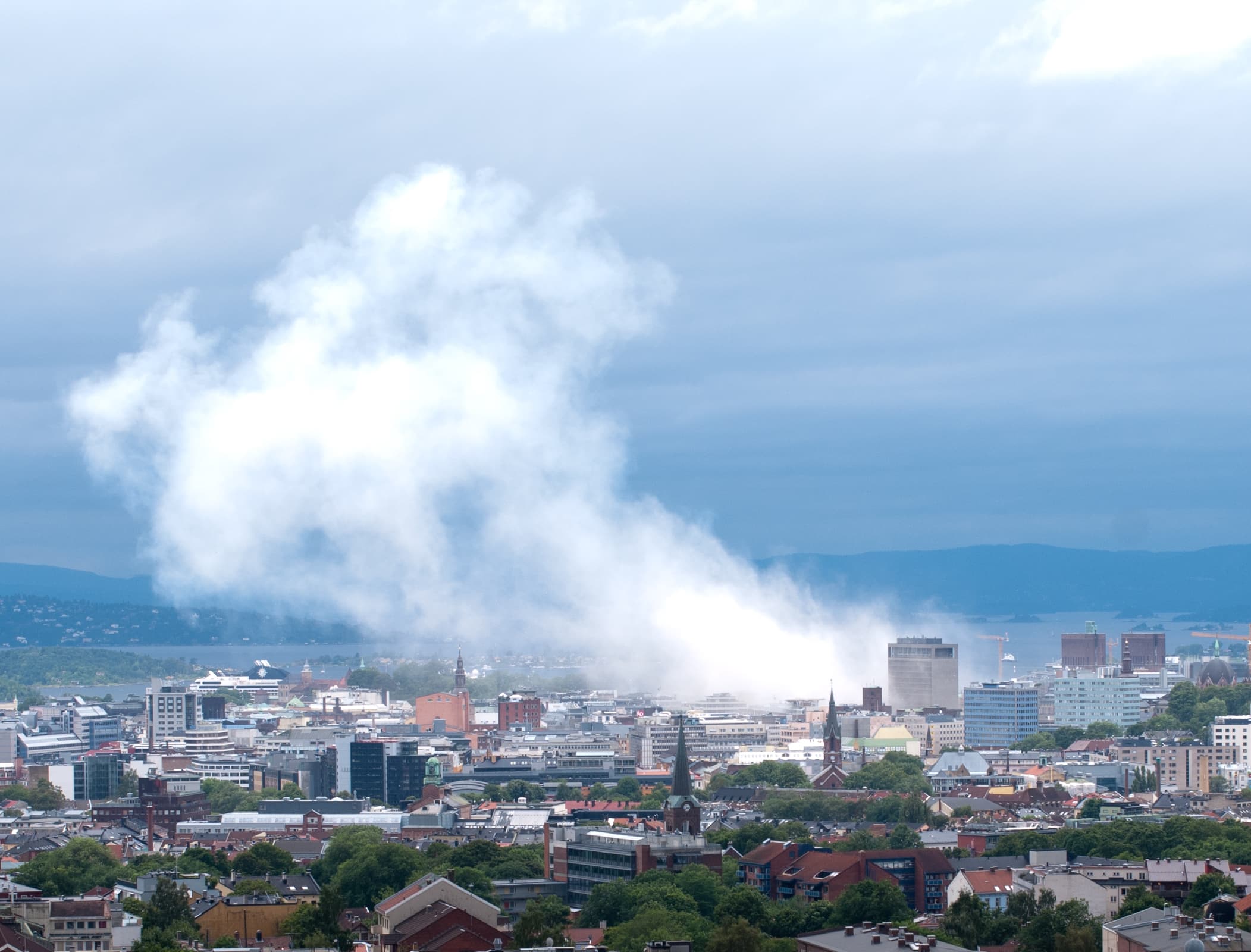
Case overview
On 22 July 2011, 32-year-old far-right extremist Anders Behring Breivik committed two domestic terrorist attacks in Norway against the government, the civilian population, and a Workers' Youth League (AUF) summer camp, in which a total of 77 people were killed. Breivik, dressed in a homemade police uniform and showing false identification, arrived at the island claiming to be performing a routine check following the bombing. [1]
His trial took place between 16 April and 22 June 2012 in Oslo District Court, where Breivik admitted carrying out the attacks, but denied criminal guilt and claimed the defence of necessity (jus necessitatis). The bomb was placed in a white Volkswagen Crafter and parked in front of the H block, housing the Office of the Prime Minister, Ministry of Justice and the Police, and several other governmental buildings, such as the Ministry of Petroleum and Energy (R4), Ministry of Finance (G block), Ministry of Education and Research (Y block) and the Supreme Court of Norway (behind the G block). The 2012 Gjørv Report concluded that Norway's police could have prevented the bombing and caught Breivik faster at Utøya, and that measures to prevent further attacks and "mitigate adverse effects" should have been implemented. [2]